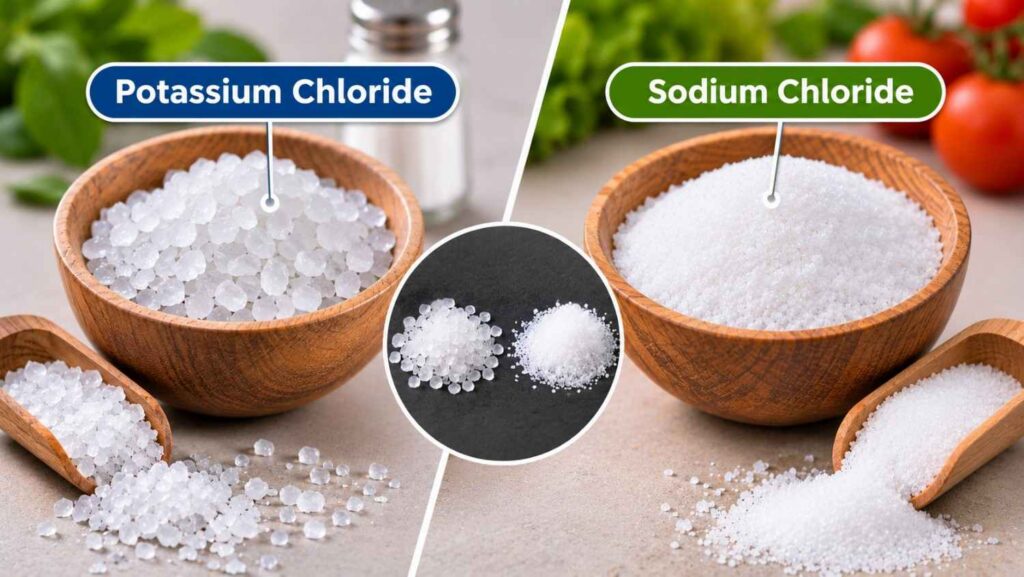
For most Ohio homes, sodium chloride is the better choice. It softens just as well, costs far less, and needs less product. Choose potassium chloride only if someone in your home must limit sodium, or you water plants with softened water.
Standing in the salt aisle, you may have noticed one bag costs about $6 and another about $60. Below, we compare cost, health, settings and environmental impact so you can decide in a few minutes. We deliver softener salt to Logan County homes every month, so these are questions we hear often.
Potassium chloride vs sodium chloride softener salt at a glance
|
Sodium chloride |
Potassium chloride |
|
|
Price per 40-lb bag |
About 5–10 |
About 50–70 |
|
Amount needed |
Baseline |
Roughly 10–25% more |
|
What ends up in softened water |
Sodium |
Potassium |
|
Softener settings |
No change |
Often needs adjusting |
|
Best for |
Most households |
Sodium-restricted diets, plants |
Do both salts soften water the same way?
Yes. Both make the brine that recharges the resin beads inside the residential softening systems we install and service across Logan County. Hardness minerals (calcium and magnesium) are flushed away, and the beads release sodium or potassium in their place. Potassium holds onto the resin more tightly, which makes it slightly less efficient, so you need more of it.
How much more does potassium chloride cost?
Several times more. Sodium chloride runs about 5–10 per 40-pound bag, while potassium chloride runs about 50–70. Because you also use more of it, the gap grows.
Here is an illustration, not your actual usage. A softener that uses ten 40-pound bags a year costs roughly $50–$100 on sodium chloride. On potassium chloride you would need about 11–13 bags, or roughly $550–$900. Hard water is common across Ohio, so softeners here recharge often, and that difference adds up quickly. To estimate your own numbers, work out your household’s monthly salt usage.
How much sodium does a softener add to your water?
Less than most people expect. According to University of Nebraska–Lincoln Extension, a softener adds about 8 mg of sodium per liter for every grain per gallon (gpg) of hardness it removes. At 10 gpg, that is roughly 80 mg/L, or about 19 mg in an 8-ounce glass. For comparison, a cup of skim milk has about 125 mg.
For most people that is minor. If your doctor limits your sodium, you have two good options: switch to potassium chloride, or keep sodium salt and add under-sink filtration for drinking water at the kitchen tap to reduce sodium in the water you drink.
Potassium is not safe for everyone. People with kidney disease, diabetes or certain medications can build up too much potassium in the blood (hyperkalemia), so ask your doctor before switching.
Do you need to change softener settings for potassium chloride?
Usually, yes. Manufacturers disagree on how much. North Dakota State University Extension says to expect about 10% more potassium chloride, WaterBoss says to raise the hardness setting 12%, and Whirlpool says to add 25% on models without a salt-type setting. Always follow your own manual, since some brands warn that the wrong salt can void the warranty. Avoid mixing both salts in one tank, because your softener can only be set for one.
Is potassium chloride better for the environment?
Only partly. Agencies such as the Minnesota Pollution Control Agency point to chloride as the pollutant from softeners, and both salts release it. Potassium is gentler on plants and soil, so it helps if softened water reaches your garden. For either salt, the bigger win is setting your softener to use less per cycle.
Which softener salt should Ohio homeowners choose?
- No one limits sodium: Choose sodium chloride. You get the same softness for far less money.
- A doctor has limited your sodium: Choose potassium chloride after checking with your doctor, or pair sodium salt with reverse osmosis at the kitchen tap.
- You are on well water with iron: Test first. WaterBoss’s manual advises against potassium chloride when iron or manganese is present, and our guide to iron in water in Ohio explains what to do.
- You water plants with softened water: Potassium has the edge.
- You are not sure: Book a free in-home water test and we will check your hardness, which tells you how much salt you will go through.
Before you switch, check what your softener’s manual allows. When you are ready, you can order softener salt from Easton with monthly delivery, or use our drive-thru in Bellefontaine, open Monday to Saturday.
Frequently Asked Questions
Is potassium chloride better than sodium chloride for water softeners?
Not for most homes. It softens just as well but costs several times more and needs more product. It is better only if you must limit sodium or you water plants with softened water.
Should I use potassium or sodium in my water softener?
Use sodium chloride unless a doctor has limited your sodium. Then choose potassium chloride, after checking kidney and medication concerns, or keep sodium salt and add reverse osmosis at your kitchen tap.
Can I switch to potassium chloride in my water softener?
Yes, most ion-exchange softeners accept it, but check your manual first. Expect to raise a setting by roughly 10–25%, depending on the brand. Some manuals restrict salt type.
Does potassium chloride soften water as well as sodium chloride?
Close. Both swap out hardness minerals the same way, but potassium clings to the resin more tightly, so it is a little less efficient. Properly adjusted, results are about the same.
Why does potassium chloride cost more than sodium chloride?
It is more expensive to extract from the ground and has lower demand. Sodium chloride comes from salt mines and solar evaporation ponds and is widely available.
Can you mix potassium chloride and sodium chloride in the same brine tank?
It is best not to. Your softener is set for one salt type, so a mixed tank leaves the settings wrong for part of the salt. Let the tank run low before you switch.
How much sodium does a water softener add to drinking water?
About 8 mg per liter for every grain per gallon of hardness removed. At 10 gpg that is roughly 80 mg/L, or about 19 mg per 8-ounce glass.